.

.

Friday, 22 January 2016

Anglo-Boer War BL 5 inch shrapnel shells Mk III


An officer of artillery who runs out of ammunition in mid-battle merits death.” Napoleon

15 Pdr. Artillery Shell: The 15 pounder shell shown here was a standard artillery shell used by horse drawn artillery pieces in the Boer War. Markings in the base identify it as a “15 PR” made for the British military.
The shell is 11” high, is capped with a brass fuse and bound with a copper “driving ring” on the bottom.  When a shell is fired it is not dangerous. It is basically just a hunk of metal which – after it is “fired” - is being spun round by the brass drive ring engaging the grooves in the barrel sending the shell spinning out the barrel.


Still not dangerous; there are many cases where artillery shells like these just hit something and made small holes in the wall or on the ground. There was no “serious” damage done because the shell simply failed to explode. However, with the specimens on display, it is clear that this was not the case and that they actually exploded.

It is the fuse which made the shell deadly. It was graduated with increments in seconds in a ring around the top. Before loading it, an artilleryman would dial in the seconds that should lapse before the shell explodes, after it has been fired.  Often, this was timed to go off as the shell was still in the air over the enemy, sending shrapnel balls – some 200 could be packed inside – down into the men covering the trenches.[1] If dispatched accurately, these shells could be extremely deadly.

The particular shells on display were found on the erstwhile Rietvly (271 JQ) farm of Dr. Dolf Smith and his wife, Mrs. Lesley Smith. This farm is located not too far away from here, somewhere in between Kedar and Rustenburg. The Smiths purchased the farm in the early nineties from Dr. Charlie Payne, who had inherited it from his father. The farm had been divided previously and Charlie's sister inherited her portion of it, she married Thinus Smit and the Smiths became their new neighbours.

Dr Smith developed his farm house halfway up the mountain on the white (and what they believe to be) dolomite rocks. In this process, he also had to make a road to access the house, drill for water and fence the place. 

The Smiths found a Boer War camp site on the farm, the rock walls were very obvious.  While fencing the farm, Dr. Smith came across these shell cases. The Smiths also discovered a furrow which extended over the mountain. They are unsure whether it was dug by the Boers or the Brits.
The Smiths donated these shells to Kedar Heritage Lodge, Conference Centre & Spa in 2015 and Mrs. Smith has the following to say:

My husband, who turns 93 years old this month (December 2015), has a particular interest in the period as his father fought in the Boer War under Gen. de Wet where his right thumb was shot off. After seeing Kedar, he said he wished he could have shown his father your collection. We took Latie, my husband’s son, who practises in Rustenburg, to Kedar last week and his reaction was, if possible, even greater than ours!”

We have always admired countries that preserve their heritage and felt that many South Africans do not appreciate what a rich history we have. We thank you for what you have done, and are doing. We are expecting our first great grandchild in May next year and it is reassuring to know that he will be able to see evidence of what transpired during that period.”


[1] http://angloboerwarmuseum.com/Boer20c_techofwar.html

Wednesday, 20 January 2016

Murals at Misty Hills Country Hotel, Conference Centre & Spa

Christopher Patton is the designer of all the beautiful murals on display at Misty Hills Country Hotel, Conference Centre & Spa. He was born in 1935 in Belfast, Northern Ireland and is a ceramic designer who also produces individual pieces of pottery and small runs of production pottery. Over the years he has produced every type of handmade ceramic, the largest being the “Setanta” mural in Dublin 40 ft long and 18 ft high. This work took two years to complete.

Chris Patton has been a full time potter for over 40 years. He obtained a degree in fine art (from the Belfast College of Art and Design, graduated in Lithography and ceramics) and was also a teacher for many years. He gained experience in potteries in France, Norway and England before establishing a studio in Hillsborough in Ireland which he ran for ten years. Chris relocated to South Africa in 1982 and established his current studio in an old deep litter chicken house on a plot near Muldersdrift where he lives and works. Chris has worked very closely with the Recreation Africa Group and, at Misty Hills Country Hotel, Conference Centre & Spa (Misty Hills) he has been responsible for:

·         The reed dance” - new reception area.
·         Lobola” - conference centre.
·         Bushman Hunters” - entrance drive way.
·         African animals” - entrance drive way.

He works mainly in stoneware but has at one time or another experimented with earthenware, porcelain, terra cotta and everything in between! Stoneware, however, remains his preferred medium. He makes his own clay, glazes and most of his colours. He works using oxides on raw glaze, decorating spontaneously with direct brushwork, very much in the Anglo Japanese tradition, looking towards sung dynasty ceramics as a yardstick.

In recent years, murals and decorated wash basins have featured amongst his work however “throwing” has always been the principal creative skill. Recently, with changing trends in ceramics he has been making production runs in terra-cotta or bisque for clients, which requires repetitive throwing. He prefers work to order when possible; in an innovative and creative sphere. His work can be seen at Misty Hills Country Hotel, Conference Centre & Spa as well as the Corobrick Collection in Pretoria.

Chris stipulates that, “the inspiration for all the works I have undertaken at Misty Hills has been African, inspired either by traditional events, animals or history. These murals are to be enjoyed and therefore I always look to a decorative and lively image using my experience of ceramics to create textures and colours unique to pottery. There is often a narrative; the reed dance and lobola for example, while others are formalised animals relying on pattern colour and texture for their statement”.


“The creation of mural is always a challenge, each one requiring a different approach and always seeking a different visual effect. I feel if I don’t get pleasure out of making these murals how can I expect anyone else to. I love my job!”

Thursday, 17 December 2015

Meet Uttam Singh

Chef Uttam Singh is one of two Indian chefs from Delhi, in the North of India, plying his trade with Recreation Africa (at Misty Hills Country Hotel, Conference Centre & Spa and Kedar Heritage Lodge, Conference Centre & Spa). His culinary journey commenced 17 years ago in Mumbai, India where he started working at the Ramee Guestline Hotel.

Mumbai's culture is a blend of traditional festivals, food, music, and theatres. The city offers a cosmopolitan and diverse lifestyle with a variety of food, entertainment, and night life, available in a form and abundance comparable to that in other world capitals. Mumbai's history as a major trading centre has led to a diverse range of cultures, religions, and cuisines coexisting in the city. This was an absolutely great place for Chef Uttam to “earn his stripes” if you will.

Chef Uttam has a wife and 2 kids and he moved to South Africa 8 years ago. He has been with the Recreation Africa group for 2 years now. He specialises in Mugalai food, Indian and Tandoori and he even dabbles in “Indian Chinese” food which he says is a spicy take on Chinese food. Apart from his love and expertise in the Indian cuisine, Chef Uttam enjoys other flavours from other cultures such as Mexican and Thai food.

Chef Uttam is an avid cricket fan and enjoys watching the Indian Premier League (IPL) where, even though he ought to be rooting for the Delhi Dare-Devils (at least from a geographical perspective), he is a Chennai Super Kings fan because, as he puts it, “they are simply the best!”.


Thursday, 10 December 2015

Meet Sabbir Ahmed

Chef Sabbir Ahmed is one of two Indian chefs from India who form part of the Recreation Africa culinary team (Misty Hills Country Hotel, Conference Centre & Spa and Kedar Heritage Lodge, Conference Centre & Spa). He comes from Lucknow city in India. Lucknow is the capital city of the state of Uttar Pradesh, India and is a major metropolitan city of India. Lucknow is also the administrative headquarters of the District and, according to Sabbir, “by far the best city in India!” It is the second largest city in north and central India, after New Delhi. Chef Sabbir then moved to Delhi where his wife, three daughters and two sons live today.

Sabbir’s journey into becoming a chef was almost non negotiable as he comes from a long line of chefs in his family. His grandfather and father were both chefs and this left little choice for Sabbir and his brother (who is also a chef) as any deviation would have been “breaking tradition”. Fortunately for Sabbir, he never felt any pressure to pursue the culinary arts and it came naturally as something he is passionate about.

Chef Sabbir been a chef since 2002 and he joined the Recreation Africa group in June 2014. He is taking the establishment’s Indian cuisine to the next level through imparting the wealth of experience that he gained at various restaurants. These restaurants include the ITC Maurya (5 star luxury Hotels) & New Delhi; Le Meridean (5 star luxury Hotels), New Delhi; Fortune in Garazia hotel and 5 star Delax hotel and world renowned restaurants including the iconic Bhukara. 


Thursday, 3 December 2015

Meet Nicolene Nortjee

Nicolene is the Pastry Sous Chef at Misty Hills Country Hotel, Conference Centre & Spa. Her journey into pastry is an interesting one. You see, Nicolene started her journey at culinary school although she wasn’t particularly interested in cooking. That is, until the first time she ever stepped into the pastry kitchen and, in an instant, she immediately fell in love with pastry! The rest, as they say, is history. One of our pre-requisites for all those associated with our brand at Recreation Africa is passion and Nicolene, particularly when it comes to  pastry (desserts and cakes too), oozes tonnes of it.

One thing you didn’t know about Nicolene’s work is that behind every cake she makes, whether
it’s a birthday, anniversary, surprise gift or a baby shower; there is a story of the person who it has been commissioned for. This story influences her creative process to ensure that the cake reflects the person and personality. She simply loves this “behind the scenes” approach to her baking as it is always a pleasure to see the look on the face of yet another satisfied client.


Nicolene’s creative process has three tenants that must be upheld each and every time she prepares something and these are perfection; she strives for perfection in every dessert, happiness; it must bring happiness to the diner and improvement; it must always be an improvement on the last dessert.

Thursday, 26 November 2015

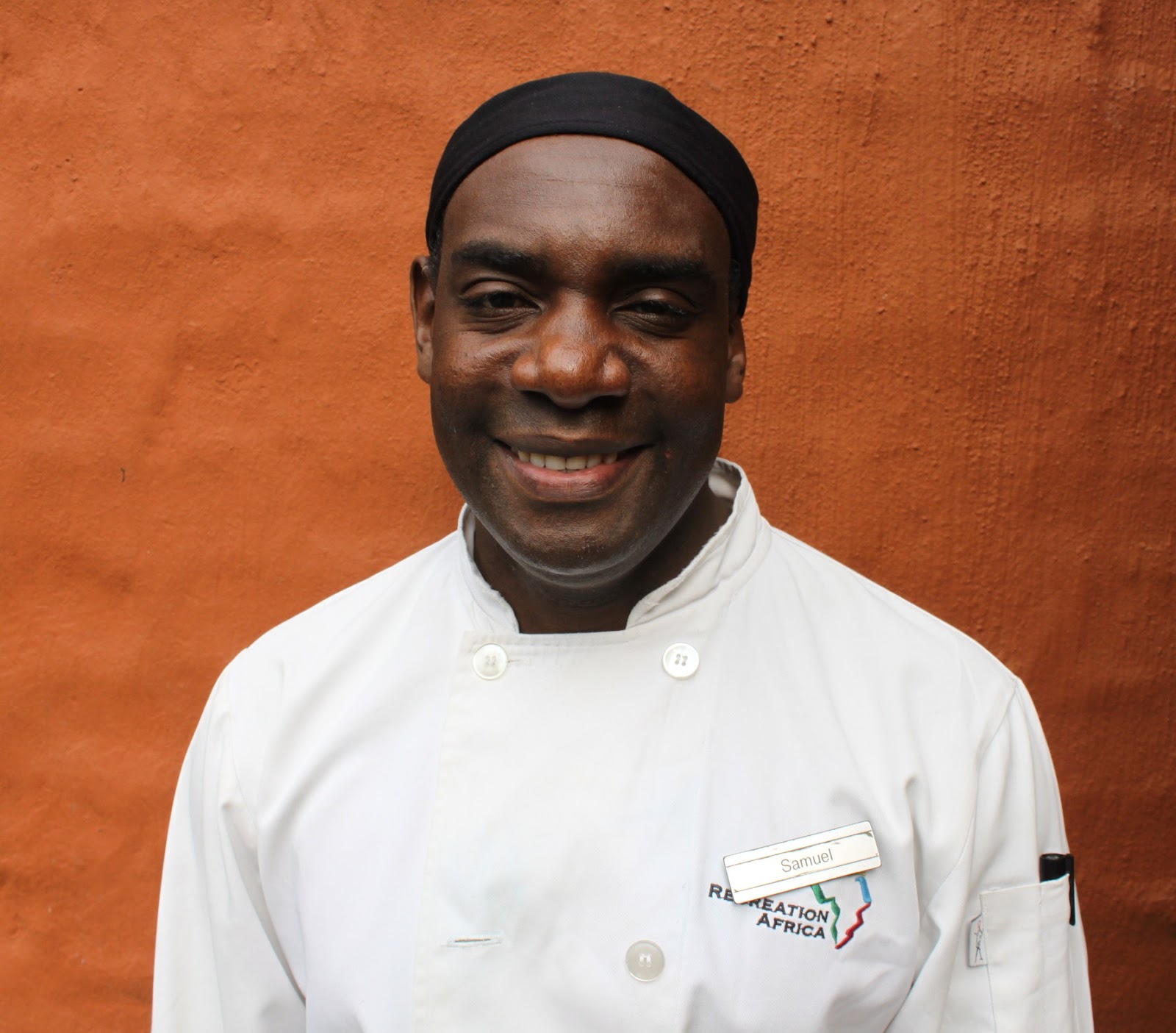
Meet Chef Samuel Mthombeni

Samuel Mthombeni is a Sous Chef and his is a true story of luck (the point at which opportunity and preparedness collide!) 12 years ago, the Executive Chairman of the Recreation Africa Group, Robert Forsyth, gave Chef Sam (then, just Sam) the opportunity of making freshly squeezed orange juice from citrus at Kedar Heritage Lodge, Conference Centre & Spa (a member of the Recreation Africa Group).

This is all Chef Sam needed to grow! You see, it is while making juice that Sam met with Chef Mori (a Russian chef working at Misty hills at the time). Mori mentored Chef Sam and introduced him to Chef Works (a culinary academy that incorporates practical and theoretical training). Chef Sam was also mentored by Kevin Morin during this period.

Chef Sam self-funded his training through Chef Works and when he was done with that, he studied further and completed a National Certificate and Diploma through Intec College. This was again with the assistance of Mr. Forsyth who gave him the requisite time off. Today he is a proud Sous Chef at Misty Hills Country Hotel, Conference Centre & Spa.


Apart from his love for cooking, Chef Sam enjoys reading books and the pursuit of knowledge. This is why he intends on taking his studies further to study Business Law with UNISA, so that some day he will own his own business in the hospitality industry. Chef Sam would also relish the chance to give others the opportunities he has been given by mentoring young people in the hospitality industry.  

Tuesday, 24 November 2015

PEOPLE DRIVEN BY PASSION

This week’s blog will share the insights of a recent visitor to Kedar Heritage Hotel, Conference Centre & Spa (Kedar). Roger Webster is a well-known voice to South African Audiences - he has been broadcasting his “Fireside Chats” on SAFM for the last 10 years. Roger’s historical and anecdotal tales based on the true history of South Africa, and not what we were taught in school, have made him a controversial and sought after speaker on the South African circuit.

Below is Roger’s account of his first visit to Kedar and the inaugural Anglo Boer War Weekend;

As a writer and story teller, preserving the tales of yesteryear has been my bent for many many years, coming across people with like-minded passions is a rare and most delightful moment.

Let me elaborate.

Some weeks ago I received a phone call telling me about a Boer War weekend  that was taking place just North of Rustenburg., this then was followed up an official invitation. It took place this weekend and I went on Friday afternoon.

Nothing could have prepared me for what I was about to experience, which I shall go into later, but first a bit of background

Robert Forsyth and his wife spent over 30 years buying up the local farms from the Kruger Family, and consolidating it into one big unit which they turned into a game farm. They established Kedar Lodge. Robert has an absolute passion for South African History and the Boer War in particular, and when the Government phoned and told him they could no longer maintain Paul Kruger’s original farm house on Boekenhoutfontein, he jumped at the opportunity, bought the property, and now, under Kedar’s care it will be properly maintained and not go to rack and ruin like so many others. Another piece of our crumbling history saved.

That’s the background.

As I said earlier, nothing could prepare you for the experience. You drive through the gated entrance, go round a corner, and there, facing you is a life size bronze statue of General Jan Smuts mounted on his favourite horse, a few meters down, a life sized bronze statue of Mahatma Gandhi, who was a stretcher bearer during that war. The next one needs a little bit of time, it is four statues representing the men involved 1 Indian, 1 Boer, 1 Brit and 1 Black. When you arrive at the reception Portcusre, a life size bronze of an old Spider with a matched pair is opposite the entrance.

Inside Reception there are glass encased, larger than life army figures, all dressed, in original assorted uniforms. This is when the penny drops; you are dealing with someone with a deep passion. Walk out of the back of reception, into the botanical like gardens, the first thing you notice, no foreign evasives, they, including the Boers most wanted and loved eucalypts trees, have all been removed, the result, all the old springs have now returned to the farm, just like it used to be those many years ago with lovely areas of wetlands, just the thing for birders.

Walk down the pathways lined with Bushveld trees and local vegetation, and the fist garden statue you come across is Kosi Magathla, how befitting too, as Maghatla was around before the war, he backed the Boers, and was given his land by Kruger’s Government, whilst the Po people, on the other side of Rustenburg backed the Brits and lost their land, but that’s another story. Magadha’s neck, on the Zeerust road is named after him, and the place down the road Fokeng, of course belongs to the BA- Fokeng people, the “people of the mist” the richest tribe in the whole world.

I could go on and on forever, but suffice to say that there are 5 stand alone statues, including Cecil John Rhodes, which led to quite a debate on Friday night, and 5 memorial statues dotted around the gardens and lawns of the Lodge.

There’s a swimming pool, a spa, and those not interested in the War have many options to follow, but this talk is not about Hotels, it’s about the preservation of culture and history.

There are many what I would describe as “Halls”. Each one serving a different purpose, but let me try and paint you a mind picture of what I mean. An Ancient thick, high walled large hall with its double volume effect, and thatched, the high pitched roof: picture the flags , all draped at an angle, all lining the side walls as you enter, the Family Crests, the Armorials, granted by none other than the King Himself. Each one belonging to a family whom would give their very life for their Sovereign Liege. Such is the feeling that overcomes one; looking down a high walled, thatched hall, the Boer war rifles, inclined at an angle slightly downwards, lining the walls like flags, each one belonging to a man that fought to protect the freedom of his family, his country and himself. It's as if each and every one of them has its own personal story to tell, and collectively speak, of eventual defeat against a mightier Foe. The feeling is electric.

The walls of all the various halls are decorated with memorabilia to vast to comprehend, here a wall with over 100 English Officers swords, with scabbards, all glass  encased an annotated, there a passage, its wall adorned with an individual  painting of every single man who won a VC during that war. Another room, dedicated to the English POW camps scatted all over the world, their letter home, their art work, There heartbreak. The one thing I learnt there was that, it was the prisoner of war that were taught to play cricket and rugby against the warders during that period, and those games were brought back, and that’s how we became a cricket and rugby playing nation!

Upon another wall, encased in glass, is a pictorial of every aristocrat from Britain, Europe, and surrounding places, which took place in the war. It just goes on and on hall after hall, conference room after meeting room.

It is without a doubt, the biggest single collection of Boer war memorabilia in the world, and if it could come to pass that it could be amalgamated with the biggest collection of cannons, which is owned by a friend of mine, it would be mind blowing!

Why do I go on and on about it? Let me tell you. Natal displays their battlefields to the fullest, Thlana, Spionkop Ihlandwana et al, The magaliesburg has over 50 battlefields and squirmishes that took place in and around the area, and it was the late great David Rattray that one said to me “I have one battle field to talk about, Islandwana, it’s not on the way to anywhere, it’s isolated, and yet people come”.  “You guys have over 50 yet y you do nothing with them”

Well that’s about to change , because yesterday, whilst this Boer war day was on, the government’s department of the North West was meeting (Yes, on a Saturday) with all the stakeholders in the area to find a way forward for the promotion of local, and foreign tourism.


And I feel that with passionate people like Robert Forsyth, John Penne father, Vincent and His Prof of history wife, Jane, the late Lionel Wolfson’s  work and all the others, the time has really come.